
How the Iran War is Shaping Global Oil Prices and Fuel Access Across Nations

Author: Ajjay Bhagyakar | Published by: Griha Realty
Source: x.com
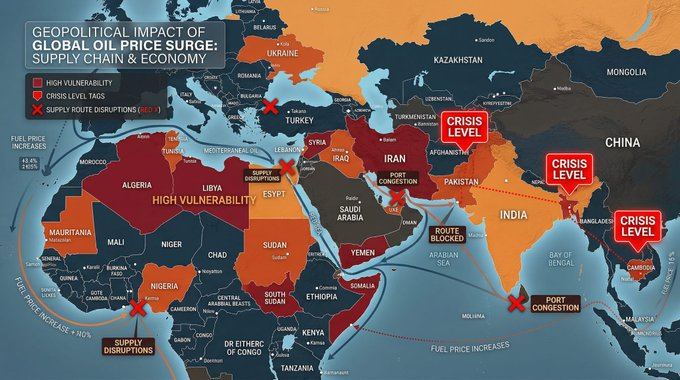
The Iran war that began on February 28 has triggered one of the largest disruptions in the global oil market in history. Within just ten days, Brent crude prices surged from $73 to $120 per barrel, while the closure of the Strait of Hormuz on March 4 cut off more than 10 million barrels per day. This sudden shock has rippled across continents, affecting fuel prices and availability in countries worldwide. Understanding how different nations are coping reveals the complex and uneven impact of this crisis.
Countries Running Out of Fuel
Several nations heavily dependent on oil imports face critical shortages. Bangladesh, importing 95% of its fuel, has seen pumps run dry, forcing universities to close. Pakistan, reliant on Gulf oil for 80% of its needs, has shut schools and introduced a four-day workweek to conserve energy. Sri Lanka has implemented rationing, mandatory fuel passes, and weekly holidays to manage scarcity. Zimbabwe also suffers severe fuel shortages, disrupting daily life and economic activity.
These shortages highlight the vulnerability of countries with limited domestic energy resources and high import dependence. The crisis forces governments to make tough choices affecting education, work, and mobility.
Countries Facing Record High Price Hikes
Some countries are not out of fuel but face steep price increases. Cambodia leads with a 68% rise in petrol prices, the highest globally. Vietnam’s prices jumped 50%, causing panic buying and shortages. Nigeria and Laos saw increases of 35% and 33%, respectively. These spikes strain household budgets and can trigger inflationary pressures in economies already struggling with other challenges.
Severe Price Pressures in the Americas
In the Americas, the United States faces a 37% increase in diesel prices, reaching $4.97 per gallon, and a 27% rise in gasoline prices at $3.72 per gallon, with California topping $5.29 per gallon. Canada’s fuel prices rose 28%, while Brazil responded with emergency fuel tax cuts to ease the burden. Mexico capped fuel prices to shield consumers from volatility.
These measures show how governments try to balance market forces with social stability, but rising fuel costs still threaten economic growth and consumer spending.
Europe’s Struggle with High Prices and Inflation
European countries face some of the highest fuel prices in the world. Ireland leads with diesel at €2.30 per liter, the highest in the EU. Germany, France, Italy, the Netherlands, Finland, and Spain all report prices above €2.00 per liter, with Spain experiencing the EU’s largest jump at 27%. The UK saw a 13% diesel price increase, pushing inflation forecasts above 5%.
To mitigate impacts, Austria and Portugal cut fuel taxes, Hungary capped prices, and France released strategic reserves. Despite these efforts, the risk of recession looms as industrial surcharges rise and consumer costs soar.
Asia’s Fragile Management of Fuel Prices
Asian countries show mixed responses. Japan, 95% dependent on Gulf oil, activated emergency reserves. South Korea, with 70% Gulf dependence, imposed a price cap for the first time in 30 years. China capped prices at an 11% increase and banned fuel exports to protect domestic supply. India kept price rises to 5% through subsidies but remains vulnerable with 85% Gulf dependence. Thailand and the Philippines declared price caps and states of emergency, respectively, while Singapore and Taiwan face LNG supply cuts from Qatar.
These actions reflect cautious management but underline the fragility of energy security in Asia.
Middle East and Africa: Pressure and Stability
Egypt raised fuel prices by 15-22% across petrol, diesel, and cooking gas. Jordan faces heavy import pressure, and Ethiopia struggles with severe energy strain. Nigeria’s 35% price increase adds to regional challenges, How the Iran War is Shaping Global Oil Prices and Fuel Access Across Nations.
In contrast, major oil producers Saudi Arabia, Russia, and the UAE maintain stable fuel supplies and prices, benefiting from their production capacity and export control.
What This Means Going Forward How the Iran War is Shaping Global Oil Prices and Fuel Access Across Nations
The Iran war’s impact on global oil prices and fuel access exposes the delicate balance of energy markets. Countries heavily reliant on imports face shortages and soaring costs, forcing governments to impose rationing, tax cuts, or price caps. Producers remain stable but face geopolitical risks that could shift supply again.




Comments